
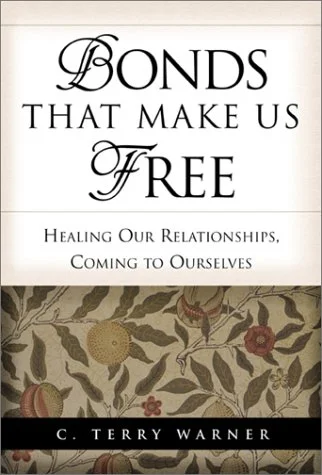
Bonds That Make Us Free: The Maddening and Gladdening Book
“Some things are only real because they represent what we think. When we learn the truth and think it, the old reality is no longer real to us and loses its hold on us. The truth sets us free.” -C. Terry Warner, Bonds That Make Us Free
When the syllabus for my Intro to Mediation class landed on my desk, I had to chuckle at the choice of text that was going to be guiding my studies. Inexplicably, as a 17 year old at the library with my family, I had picked up Crucial Conversations and later, after such a natural page-turner for a teenager, its sequel, Crucial Confrontations. Now in college, I was to read it again and put it to use in mediation training.
This happened a few times throughout the course of learning the behavioral sciences, where the texts were books I had read in my late teens. I blame Oprah. Many an afternoon in my childhood was spent watching the show with my mom. Talk about tween gold mine, right? It was practically Twilight for the 90’s. Or at least I responded to it that way. Due to my growing interest in watching grown women talk about their weight and self-esteem issues, I devoured self-help and relationship books. I became my very own, self-proclaimed, relationship/self-help expert. Key word: self-proclaimed. In lieu of my own experiences, I observed other’s relationships, listened to what the doctors on TV had to say, and read a lot of books. As for me, I didn’t have a serious relationship until I was 22, and even then I’m using the term “serious” about as loosely as Fox News uses “Fair and Balanced”.
Before getting married, I told Jon there were a few of my favorite “love doctor” books I had always hoped my future spouse would read. We agreed to each read the other’s five favorite books. One he gave me is called Bonds that Make Us Free by C. Terry Warner. If you’ve heard of the Arbinger Institute or Leadership and Self-Deception, it’s all done by the same people with the same concepts. This one is just ultra in-depth and covers pretty much everything you ever need to know. It's not religion-based, but does align neatly with certain religious concepts if you choose to think of the ideas in that way.
This book did a few things for me:
1) Singlehandedly blew up my imagined status as a relationship expert
2) Frustrated me with its truthfulness; it’s the kind of true that sucks because you have to do something about it.
3) Made me very happy
Many times after reading a book I will proclaim it is the best, most life-changing book I’ve ever read, instantly leading an all-out campaign to get others to read it...for about a month or until I read a different book that trumps it. I felt that way about this book, but the difference? Six months and at least 15 books later, I still feel it. This book was different in that it actually made its way into my life in tangible ways- my mind, actions, and most importantly, my heart, are different.
It initiated a paradigm shift, impacting the very way I look at all things relationships. Other books teach methods and techniques. Behaviors to emulate, steps to follow. This book builds a foundation for relationships to be built upon so that the behaviors come naturally and intuitively without having to try so hard with a list of how-to’s.
The whole book is based on the premise that you can act however you want. But if your motives, feelings, or thoughts are angry, blaming, resentful, etc. then whoever we are interacting with at that moment will feel it. This isn’t energy healing or anything, it’s the idea that we can’t hide our true intentions. Somehow, whether in our face, the tone of our voice, body language, or word usage, we will reveal ourselves. And in so doing, usually the other person behaves in kind. Once they do, we then decide that they deserve whatever we are giving them because their behavior justifies it. Forget the part about how we started it in the first place. In short, it makes an excellent case for how nothing anyone does is ever an excuse to blame them for how we are feeling or behaving.
The author calls acting in a blaming or judging way “self-deception”. He gives many examples of how this looks in everyday life. One simple example is this: A man and woman are in bed, their baby is sleeping in the other room. The baby cries in the middle of the night. The man hears the baby first, the woman is still asleep. He thinks, “I should go get the baby and let my wife sleep. She does so much for our family.” But then, his fatigue takes over and he doesn’t go right away. Thus, in that moment, by turning from the little nudge to do the right thing, he has deceived himself.
As he continues to lie there, he begins to think things like, “Well, I have to get up early tomorrow and go to work. She doesn’t have to… plus, I have gotten up three times this week already.” This thought pattern continues until his wife, who has been in the exact same position, nothing has changed, now appears to him as a selfish, lazy, fake-sleeper who is trying to make his life more difficult. Thus now, even if he does get up to get the baby, he feels like he is doing the world a great favor. His wife should be so grateful to him.
What happened? Literally nothing had changed about the situation in the two minutes since he first heard the baby, other than the fact that he felt he should get up, but didn’t. His wife is still the woman he thought he should serve, as she “does so much for the family”. Yet, he has now become “in the box” of self-deception, unable to see the situation clearly.
In the morning, she doesn’t mention anything about him getting up. He feels angry toward her, even though he knows she really didn’t do anything wrong. When they talk at breakfast, he is a little short. She responds in kind, not knowing what his deal is. Because of her reaction, he is now able to feel validated in his assessment that she is selfish and doesn’t care about his efforts. She begins to feel the same way and act accordingly, and so the cycle of self-deception is set into motion.
The only way it will stop is if one of them chooses to see things clearly, take responsibility for their own actions, and begin to be kind. To decide that they will look at the situation from the other’s perspective, assume the best, and act appropriately in spite of the other person’s behavior. When done this way, the other person soon only has their own behavior to look at, and loses the chance to blame the other. Odds are that they will then begin to soften and understand that the problem is with them.
After reading Bonds That Make Us Free, the level of responsibility for my own life and feelings that I came away with was immense. It gave clear antidotes to destructive thought-patterns such as:
- I am angry/mean/negative/critical/offended because you did XYZ to me.
- My boss makes my job miserable.
- It’s your fault I’m unhappy in our marriage.
- If you would only do XYZ differently, I wouldn’t be so upset with you all the time.
- I want to change for the better, but every time I try, my spouse/parent/sibling/friend/boss does something to ruin it.
- I can’t have a healthy relationship because of XYZ that was done to me in my childhood.
- If I don’t nag my husband, he will never do the things he should do.
- I shouldn’t have to treat my neighbor with compassion, because she has never been friendly to me.
You see the theme: placing any blame on another person for how you are feeling, behaving, or living life, IS the problem. So often we think that another person is the problem, and if only they would change, our life would be perfect. I repeat: believing that another person is the problem, IS the problem. You can see why I said it's a little frustrating. Oftentimes blaming is so much easier than taking action yourself to improve the situation.
A quote from the book:
“Fable: When we're stuck in troubled feelings we believe that all our feelings are true-- that is to say, we believe that by our emotions at that moment we are making accurate judgments about what's happening. If I'm angry with you, I'm certain that you are making me angry.
Fact: Though we truly have these feelings, they are not necessarily true feelings. More likely I'm angry because I'm misusing you, not because you are misusing me.”
Any, and I mean any, issue we are struggling with in conjunction with another person is within our power to solve. Let me be clear: it is not within our power to stop them from doing whatever they are doing. They could be acting really poorly. But it is always within our power to get out of victim mode and be in control of our own happiness and contentment with life. This doesn’t necessarily mean we should stay in a bad situation, or continually welcome destructive people into our lives. It simply means that if I say another person is responsible for my life in any fashion, I am in the wrong and the problem is with me, not the other person.
Some will say that there are times when they truly are the victim. Heinous crimes against them, brutality toward someone they love, child abuse, etc. In those cases, a victim is absolutely the victim and is not to blame for what happened to them. However, it does not mean that the person who was victimized must have a victim mentality the rest of their life. Giving things from the past, or other people’s bad behavior the power to cause us to live a less-than life, is choosing to live a life of self-deception.
The book explains the problem so much more eloquently and completely than I just did. It makes it so easy to see where you have walked down the path of self-deception in all areas of life. Even having the thought, “So-and-so needs to read this book! That would solve everything in our relationship!” is itself self-deception. I love it because it gives the reader all the power. Everything we need to do to improve our relationships and life is within our power. Not easy, but it’s there.
The solutions in this book aren’t in self-help-how-to mode. They are large concepts that have to be carefully customized to each individual’s life. However, I have seen amazing progress in my life and the lives of others who have adopted the concepts. It’s a life-long pursuit, as is everything to do with more perfectly loving others and ourselves. It is worth it!